
As the warm sunlight peeked through the blinds on a Saturday morning, I opened my eyes and realized I'd slept twelve hours straight. I crashed on the couch watching new Netflix episodes of Grace & Frankie around 8:30 p.m., and somewhere around 2:00 a.m. I made my way to bed. When I turned to look at the morning alarm clock, I was stunned to see I'd slept until 8:34 a.m. Clearly, my mind, body, and soul needed rest. January has been a hell-of-a-month.
My Facebook feed this week has been littered with teacher memes about how long the the first month of the year is for teachers. Although I'm currently not in the classroom, I'm starting to think I'd prefer "teacher tired" over "systems change" tired.


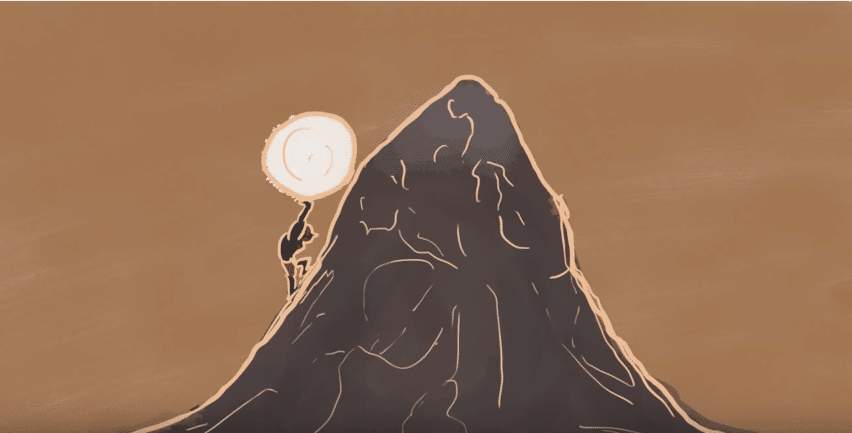
When I got home from work yesterday, I said to my husband, "In this role as a literacy coordinator/coach, I feel like I'm rolling a boulder up a hill only to see it come crashing back down almost daily." He smiled and asked if I knew about the Myth of Sisyphus. I snuggled up next to him and we proceeded to watch the TED-Ed video linked below.
Within seconds, I identified with the futility of Sisyphus's plight. Chris asked me if I thought I was being punished by the proverbial gods for leaving the classroom, and before I answered, I paused—weighing my words carefully.
The story I've been telling myself goes something like this, "I was born to be a teacher. The four walls of my classroom gave me stability, continuity, and predictable structures that provided a sense of competence and control. Because I desired to have greater influence, I stepped outside of my comfort zone, and instantly everything felt terrifying and impossible. Almost three years later, I still question my ability to adapt and assimilate in a world that constantly makes me feel powerless."
The way I frame the narrative dictates how I feel about my work. On hard days (or weeks or months), I rarely pause to interrogate whether or not the story I'm telling myself is accurate, true, or complete. Who have I turned into a villain? What conclusions have I drawn that might be false? Do I have all the details correct? From moment to moment, the story changes, and because I currently reside in a feedback desert, I don't always know what to do when I receive criticism from leaders and teachers who have never walked in my shoes.
In this work, I often feel like I am spinning my wheels. It's an uphill climb, and the whole "two steps forward—three steps back" idea constantly rings true. From time to time, I see glimmers of hope and recognize the work I do matters. But more often than not, I feel defeated, frustrated, and dissatisfied. Thus, the reason I relate so much to Sisyphus.
There are days I feel the need to write in order to make sense of all the conflicting emotions I'm experiencing. Today is one of those days. As I sat down to compose this blog, I did a little research and I stumbled across the Medium article linked below. It offers a perspective I hadn't considered, and I'm choosing to look at the boulder as a gift. I may surrender to gravity as some point, but for now, I'm choosing to embrace the rock.
In this work, I often feel like I am spinning my wheels. It's an uphill climb, and the whole "two steps forward—three steps back" idea constantly rings true. From time to time, I see glimmers of hope and recognize the work I do matters. But more often than not, I feel defeated, frustrated, and dissatisfied. Thus, the reason I relate so much to Sisyphus.
There are days I feel the need to write in order to make sense of all the conflicting emotions I'm experiencing. Today is one of those days. As I sat down to compose this blog, I did a little research and I stumbled across the Medium article linked below. It offers a perspective I hadn't considered, and I'm choosing to look at the boulder as a gift. I may surrender to gravity as some point, but for now, I'm choosing to embrace the rock.
What we can learn from Sisyphus and his rock
Let me start with a small introduction on Sisyphus. Sisyphus was a cruel Greek king who was punished to push a large rock up on a steep hill, only to find it rolling back on nearing the top. Ever since, he has been known for pushing the rock tirelessly till eternity.

No comments:
Post a Comment